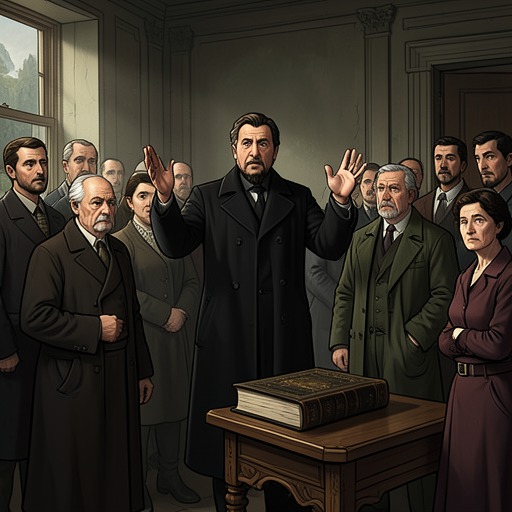
The Doctrine and Covenants
Under the Banner of HeavenThe Doctrine and Covenants is a collection of revelations attributed to God and received by Joseph Smith and later leaders of the Church of Jesus Christ of Latter-day Saints. In the book’s account of Mormonism, it is not simply a record of the faith’s beginnings: it preserves the claim that divine instruction continues, and that such instruction can establish, revise, or reaffirm religious obligations. Its sections have consequently served both as scripture and as grounds for disputes over which authorities may interpret a commandment, whether it remains binding, and how religious law relates to civil law.
Identity and Compilation
The book gathers revelations into a comparatively thin volume, setting them out as divine guidance for the church. Its authority rests in part on their status as continuing communication from God, rather than on the idea that revelation ended with the founding of the religion. Joseph Smith’s revelations were compiled there alongside later material; during his lifetime, 135 of his revelations were canonized, with many others never published. By the mid-1840s, the volume already reflected substantial theological change. The religion practiced in Nauvoo had developed in significant ways from the faith first established in Palmyra.
The book’s role grew beyond supplementing the Book of Mormon. In the account presented here, continuing revelation is a foundational Mormon tenet, and The Doctrine and Covenants became, in some respects, the Latter-day Saints’ most consequential scriptural text. Its importance comes not just from preserving foundational teachings but from recording commands that could shape collective practice and claim authority over the present.
Continuing Revelation and Varied Instruction
The revelations address both expansive theological claims and practical matters. Section 85, revealed to Joseph Smith on November 27, 1832, foretells a mighty and strong figure who will set the house of God in order. Later fundamentalist readers made this passage a focus of expectation: some believed that the promised figure was already among them and would restore the church to its former path. The passage thus became more than a record of an earlier revelation; it offered a way to interpret the church’s present condition and anticipate its future.
Other sections carried different kinds of instruction. Section 89, the Word of Wisdom, famously prohibits tobacco and strong drink. Its language concerning wholesome herbs later prompted Dan Lafferty to wonder whether scripture permitted the use of mind-expanding plants. He connected that reading to his wider conviction that religious documents should be followed literally. Section 90, as DeLoy Bateman recalled it, encouraged study and learning; Bateman invoked that teaching in objecting to restrictions on books and education in his community. Section 136, Joseph Smith’s successor Brigham Young’s sole canonized revelation, was notably practical: it specified how the Saints should organize their wagon trains for migration to Utah. Together, these examples show a collection that presents divine authority as addressing belief, conduct, learning, and communal organization.
Nauvoo and Section 132
Among the book’s most consequential sections is Section 132, which records the revelation on plural marriage formally codified by Joseph Smith on July 12, 1843. The text presents plural marriage as a sacred covenant, not a peripheral custom. Joseph taught that it was necessary to the fullness of exaltation and that those to whom the law was revealed were obligated to obey it. Its canonical inclusion gave the practice a durable scriptural basis within the church.
The revelation entered a broader period of theological innovation in Nauvoo. During these years Joseph also introduced vicarious baptism for the dead, the temple endowment ceremony, and teachings that God had once been a man and that men could become gods. Section 132, however, had a particularly destabilizing history. Unlike the other revelations described in this period, it remained secret and was not acknowledged publicly until 1852, eight years after Joseph’s death. The book therefore preserves a doctrine whose public disclosure and religious consequences came after the prophet who recorded it had been killed.
The section’s authority outlasted the church’s official practice. The Church of Jesus Christ of Latter-day Saints publicly renounced plural marriage in 1890, but the revelation remained part of accepted Mormon scripture. Fundamentalist readers argued that the 1890 declaration had suspended the practice only under temporary circumstances rather than revoked the underlying commandment. For them, the continued presence of Section 132 in the canon was evidence that the obligation endured.
Scripture, Law, and Competing Authorities
The book’s authority also informs the conflict between divine commandments and civil law. Brigham Young held that God’s law took precedence over human law, and the Latter-day Saints’ defense of plural marriage drew on the claim that it was a protected religious practice. In Utah Territory, a Mormon-dominated legislature expanded the power of local probate courts, many presided over by Mormon bishops. Church influence over judges and juries meant that local legal decisions could follow religious leadership, while federal authority was formally supposed to reside in federal courts. The dispute was therefore not only about what scripture taught, but also about who could enforce the rule and which legal order would prevail when church practice and national law conflicted.
Dan Lafferty’s reading illustrates how scriptural authority could extend beyond church governance. His studies led him to treat The Doctrine and Covenants, the Book of Mormon, The Peace Maker, the United States Constitution, and the Declaration of Independence as sacred texts whose language demanded literal obedience. His conclusions about government licensing, taxation, and personal autonomy combined scriptural interpretation with arguments about constitutional rights. The book’s significance in this setting lies partly in how its authority could be taken up by individual readers, outside an established church hierarchy, to support their own claims about law and obligation.
Later Disputes and Interpretive Afterlife
After the 1890 Manifesto, conflict over plural marriage centered on whether a later declaration could cancel an earlier revelation. Fundamentalist readers held that Section 132 remained binding because it was still scripture. They also drew support from a revelation attributed to John Taylor, received on September 26, 1886, while he was hiding from federal officers seeking to enforce anti-cohabitation laws. It affirmed that divine commandments remained obligatory unless revoked by God or by his authority, and declared the law of plural marriage unrevoked. In this interpretation, the later revelation confirmed rather than displaced Section 132.
Section 85 generated a different kind of continuing expectation. Its promise of a figure who would put the house of God in order gave some fundamentalists a scriptural framework for believing that a divinely appointed leader would restore the church. Across these disputes, The Doctrine and Covenants functions as both a record of past revelation and a resource for judging religious change. Its teachings could be cited to defend an established church’s doctrine, challenge its later policies, or anticipate a corrective authority still to come. The book’s history, as presented here, turns on that persistent question: whether a religious institution may set aside a commandment its own canon continues to preserve.